
Shaped by Land and Sea
From prehistoric settlements and early Christian monasteries to Vikings, Normans, seafarers, fishermen and revolutionaries, Howth’s history has always been shaped by its position between land and sea.
The Timeline
The earliest known evidence of human activity on the Howth peninsula comes from a shell midden excavated at Sutton, just west of Corr Castle, and radiocarbon-dated to around 5250 BCE. The midden contained mollusc shells, animal bones, flint tools and small stone axes, suggesting a temporary campsite used by mobile hunter-gatherer communities who exploited the rich coastal shoreline for food.
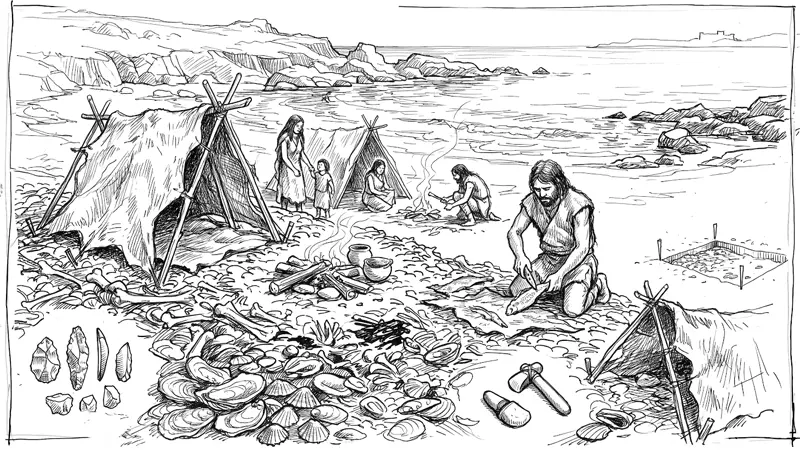 From around 4000 BCE, farming communities began to establish themselves in Ireland, marking the transition from the Mesolithic to the Neolithic period. Howth became a place of more permanent settlement, and evidence of the period can still be seen in the burial monuments found across the peninsula.
Burial cairns on four of Howth’s summits — Shielmartin, Dunhill, Kilrock and Carrickbrack — suggest that the peninsula held importance for the communities who lived here during this period of farming, monument-building and changing ways of life.
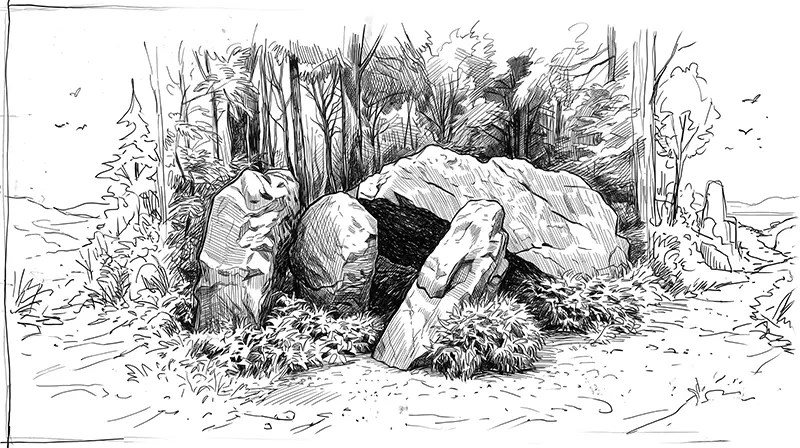
One of Howth’s most remarkable prehistoric monuments is the portal tomb known as Aideen’s Grave, located in the grounds of Howth Castle.
Dating to around 2500 BCE, the tomb is a Neolithic megalithic monument. Its enormous quartzite capstone is estimated to weigh approximately 75 tonnes. The monument is one of the most striking surviving examples of prehistoric burial architecture in the Dublin area.
The name Aideen’s Grave comes from Irish legend rather than archaeological evidence. According to tradition, Aideen was the daughter of Aengus of Ben Edar and the wife of Oscar, son of Oisín and grandson of Fionn mac Cumhaill. Oscar is said to have died at the Battle of Gabhra, traditionally dated to 284 CE. Aideen, overcome with grief, is said to have died and been buried at Howth, where Oisín raised a great cairn over her grave.
The legend has become an enduring part of Howth’s cultural heritage, linking the ancient landscape with the mythology of the Fianna.
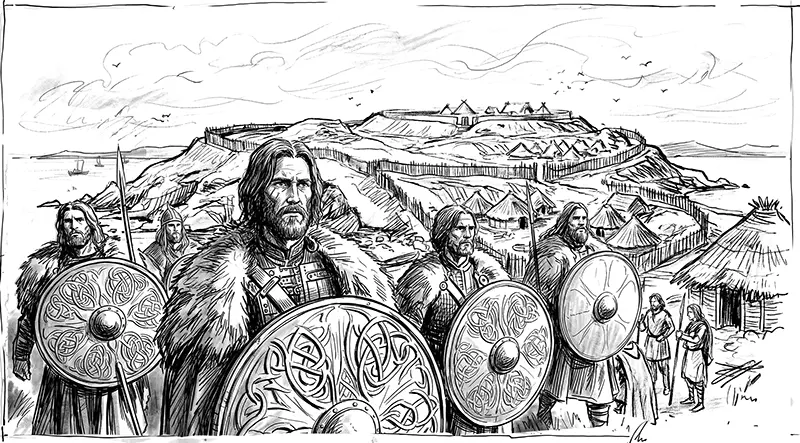
By the Iron Age, Ireland was home to communities whose languages and cultures were part of the wider Celtic world. Rather than a single mass migration of Celts into Ireland, the development of Celtic language and culture appears to have been a more complex process involving interaction, cultural change and movement over many centuries.
Howth has strong connections with this Celtic heritage. Its Irish name, Binn Éadair, means approximately “Éadar’s Peak” or “Éadar’s Hill”. In Old Irish, the name appears in forms such as Étar.
Irish mythology also connects Howth with the Fir Bolg and other legendary figures. One tradition associates the name Étar with Étar, the wife of one of the Fir Bolg chieftains, who is said to have died at Howth. Whether legendary or historical, these traditions demonstrate how deeply Howth’s landscape became embedded in Ireland’s mythology and place-names.
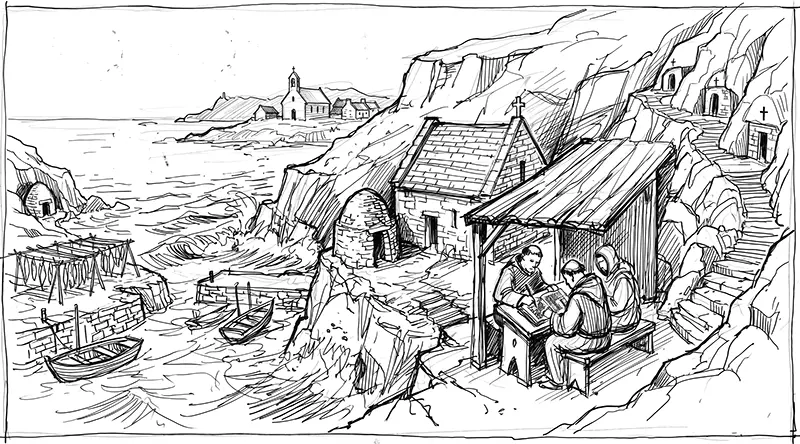 Christianity reached Ireland gradually between the third and fifth centuries, and by the early medieval period it had become deeply established across the island. Monastic communities became important centres of religion, learning, art and manuscript production.
Howth became part of this developing Christian landscape. Monastic communities were established both on Ireland’s Eye and at Sutton, and their remains can still be seen today.
On Ireland’s Eye, the monastery known as Cill Mac Neasáin, meaning “the church of the sons of Nessan”, was established sometime between the sixth and eighth centuries. The island was subsequently known as Inis Mac Nessan. A small monastic community lived there and is traditionally associated with the production of the Garland of Howth, an illuminated Gospel manuscript now preserved in Trinity College Dublin.
These early monasteries connected Howth to the wider network of religious communities that made early medieval Ireland an important centre of Christian learning and manuscript culture.
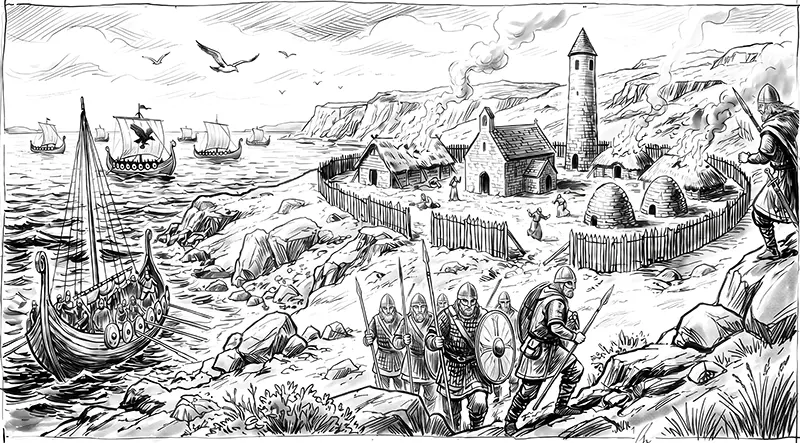 The arrival of the Vikings brought a new chapter to Howth’s history.
The Vikings established themselves along Ireland’s eastern coast from the late eighth century, with a base at Lambay Island traditionally dated to 795. Howth, with its sheltered harbour and prominent headland, became an important landing place and navigational landmark for Norse seafarers.
Howth Head was particularly valuable to ships approaching Dublin Bay, and the peninsula became part of the wider Norse maritime network that developed along Ireland’s east coast.
By the mid-ninth century, the Norse had established a longphort — a fortified ship base — at the mouth of the River Liffey. This settlement developed into Dublin, transforming the political and economic landscape of the region.
The English name Howth is generally derived from the Old Norse höfuð, meaning “head”, reflecting the peninsula’s distinctive position overlooking Dublin Bay.
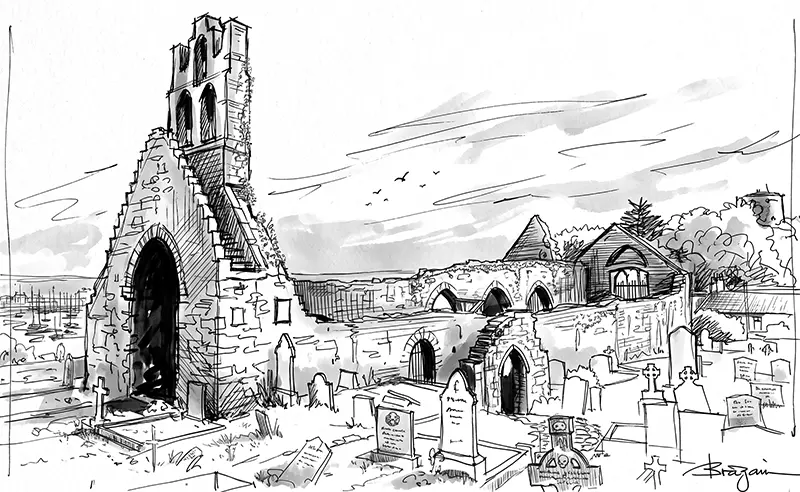 The Norse influence on Howth continued long after the first Viking raids.
In 1042, Sigtrygg (Sitric), King of Dublin, is traditionally credited with founding a church on the site now associated with St Mary’s Abbey, overlooking Howth Harbour. The foundation reflects the continued importance of Howth within the Norse-controlled world of Dublin.
Following the arrival of the Anglo-Normans, the church was rebuilt and enlarged. Around 1235, it was incorporated with the older monastic foundation on Ireland’s Eye, whose community had by then moved to the mainland.
The building visible today contains elements dating from several centuries, with much of the surviving structure dating from the fourteenth to sixteenth centuries. It was developed under the patronage of the St Lawrence family, who would become the dominant family in Howth.
One of the church’s most striking surviving features is the chantry tomb, carved around 1470, depicting Christopher St Lawrence and his wife Anne Plunkett, surrounded by representations of the Crucifixion and the saints.
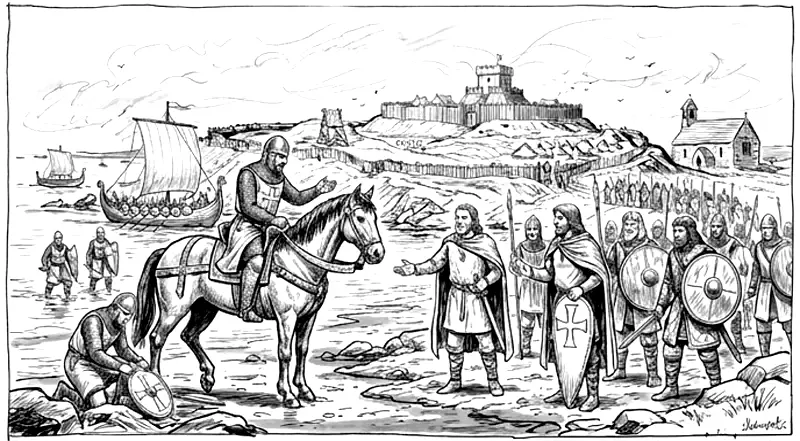 Nearly 350 years after the Vikings first invaded, the Normans arrived in 1169. Descendants of the French Viking Rollo, they were granted Normandy by Charles the Simple to protect him from other Vikings. Rollo’s illegitimate grandson, William the Bastard, later became William the Conqueror after defeating the English at the Battle of Hastings in 1066. He swiftly and thoroughly conquered England.
The Norman forces landed in Ireland following an invitation from Dermot Mac Murrough, the deposed King of Leinster. This marked the beginning of the Anglo-Norman intervention in Ireland.
King Henry II purchased Ireland from Pope Adrian IV for a mere penny per household annually, a transaction known as Laudabiliter. This purchase also involved the imposition of the Gregorian reforms on Ireland’s independent Celtic Christian Church, effectively introducing Roman Catholicism and suppressing Celtic Christianity.
The campaign was led by figures like Richard de Clare, Earl of Pembroke, better known as Strongbow. Subsequently, Henry II of England arrived in 1171.
The Anglo-Norman conquest transformed Ireland’s political landscape, establishing the Lordship of Ireland, which endured in various forms for centuries.
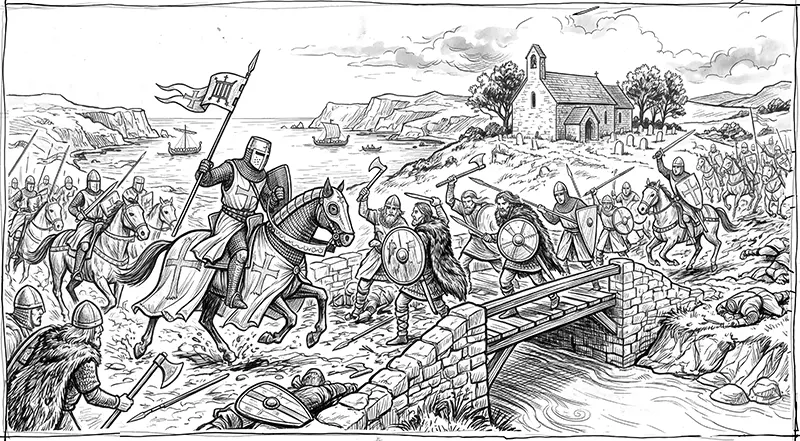 According to traditional accounts, on 10 August 1177, an Anglo-Norman force led by Sir Armoricus Tristram and John de Courcy landed at Howth and fought the local Hiberno-Norse inhabitants at what became known as the Battle of Evora Bridge.
The battle is traditionally said to have taken place near a small stream known as the Bloody Stream, close to the site of Howth railway station today.
Surviving accounts of the battle are not entirely certain and some details are based on later traditions. According to the story, Tristram emerged victorious on the feast of St Lawrence and subsequently adopted the name St Lawrence. His descendants became the St Lawrence family of Howth. The family established a stronghold on Howth and later developed Howth Castle, beginning a connection with the peninsula that would last for more than 800 years.
The St Lawrence family remained closely associated with Howth until the twentieth century. In 1909, the title passed through the female line to the Gaisford-St Lawrence family. The family’s direct ownership of Howth Castle finally ended in 2019, when the estate was sold.
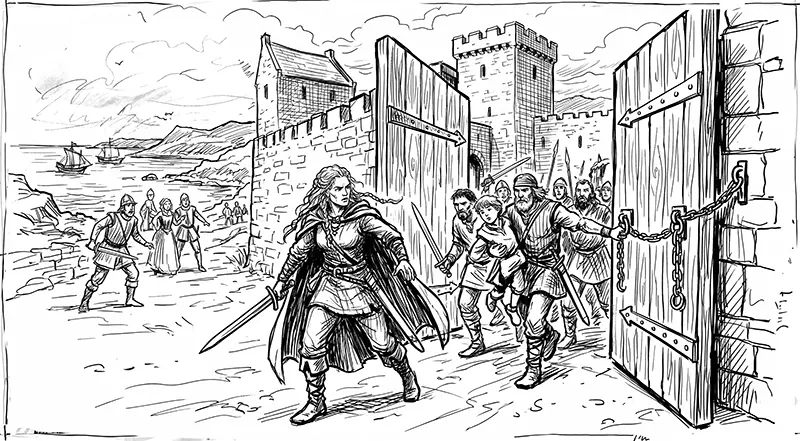 By the sixteenth century, Howth was firmly established as an important coastal settlement, with strong maritime connections. It was during this period that Howth became associated with one of Ireland’s most famous seafarers: Grace O’Malley, or Granuaile (c. 1530–1603).
Born into the O’Malley seafaring dynasty of County Mayo, Grace became a powerful maritime leader and a skilled political negotiator. She resisted English expansion in the west of Ireland while maintaining control over her family’s territories and maritime interests.
Her connection with Howth is preserved in the famous story of the “Abduction of the Heir”, traditionally dated to around 1575. According to the story, Grace O’Malley arrived at Howth Castle seeking hospitality but was refused entry because the family was dining.
She subsequently abducted the young heir of the St Lawrence family.
The story ends with a remarkable agreement: after his release, the St Lawrences were required to keep a place set at the dinner table for an unexpected traveller and to keep the gates of Howth Castle open to visitors.
Whether every detail of the story is historically accurate or not, the tradition has become an enduring part of Howth’s identity and is often linked to the hospitality associated with the area to this day.
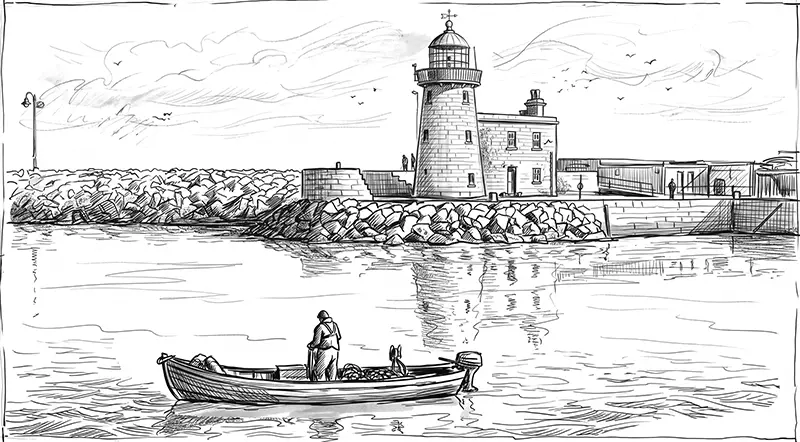 For centuries, Howth had been a fishing and maritime community. In the early nineteenth century, however, the harbour was transformed into a major piece of maritime infrastructure serving Dublin and its connection with Britain.
In 1801, Captain William Bligh, famous for his role in the Mutiny on the Bounty, surveyed Dublin Bay for the Ballast Board and identified Howth as a suitable location for a major harbour.
Construction of the harbour began in 1807, with Captain George Taylor initially responsible for the East Pier. After problems with the construction, John Rennie took over the project and oversaw the development of the harbour, including the West Pier.
The harbour was substantially completed by 1813, with its great granite piers creating the sheltered harbour that remains one of Howth’s defining features.
Howth subsequently became an important mail packet station, connecting Dublin with Britain. The road network was also improved to support the movement of passengers and mail between the harbour and Dublin.
Captain William Bligh was closely involved in the development of Dublin’s maritime infrastructure during this period and lived in Howth.
However, Howth’s importance as a mail port did not last indefinitely. As steamships became larger, the harbour’s depth became a problem, particularly because of silting. The mail packet service was eventually transferred to Kingstown (now Dún Laoghaire), whose deeper harbour was better suited to the increasingly large steamships.
Howth then developed increasingly as a major fishing port. By the nineteenth century, large numbers of fishing boats operated from the harbour, particularly during the herring season.
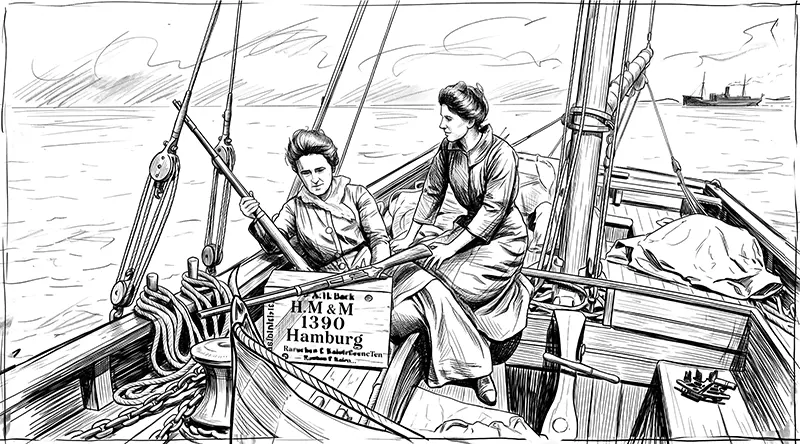
Howth’s maritime history took on a new political significance in the years leading up to the Irish War of Independence.
On 26 July 1914, Erskine Childers’s yacht, Asgard, sailed into Howth Harbour carrying approximately 900 Mauser rifles and 29,000 rounds of ammunition for the Irish Volunteers.
On board were Erskine Childers, his wife Molly Childers, Mary Spring Rice, Gordon Shephard, and two Donegal fishermen, Patrick McGinley and Charles Duggan.
The landing took place in broad daylight rather than under cover of darkness. Hundreds of Irish Volunteers and members of Na Fianna Éireann gathered at the harbour to receive the weapons.
Volunteers formed lines along the pier, passing the rifles and ammunition from hand to hand. The weapons were then carried away from the harbour by bicycle, motor car and on foot.
The Howth gun-running became one of the defining events of the Irish nationalist movement before the First World War. Many of the rifles were subsequently used by the Irish Volunteers during the Easter Rising of 1916 and during the Irish War of Independence.
What began as a daring maritime operation at Howth Harbour therefore became an important part of the chain of events that led to the establishment of the Irish Free State in 1922.
From prehistoric settlement and early Christian monasteries to Vikings, Normans, seafarers, fishermen and revolutionaries, Howth’s history has always been shaped by its position between land and sea.
